Quick answer
RobinFocus is an online pomodoro timer built to help people build positive focus habits through calm focus blocks, tomato-based rewards, unlockable assets, and a structured rhythm for study and deep work. Inside RobinFocus, users are Robins, completed blocks are tomatoes, and consistency drives progression.
What RobinFocus is
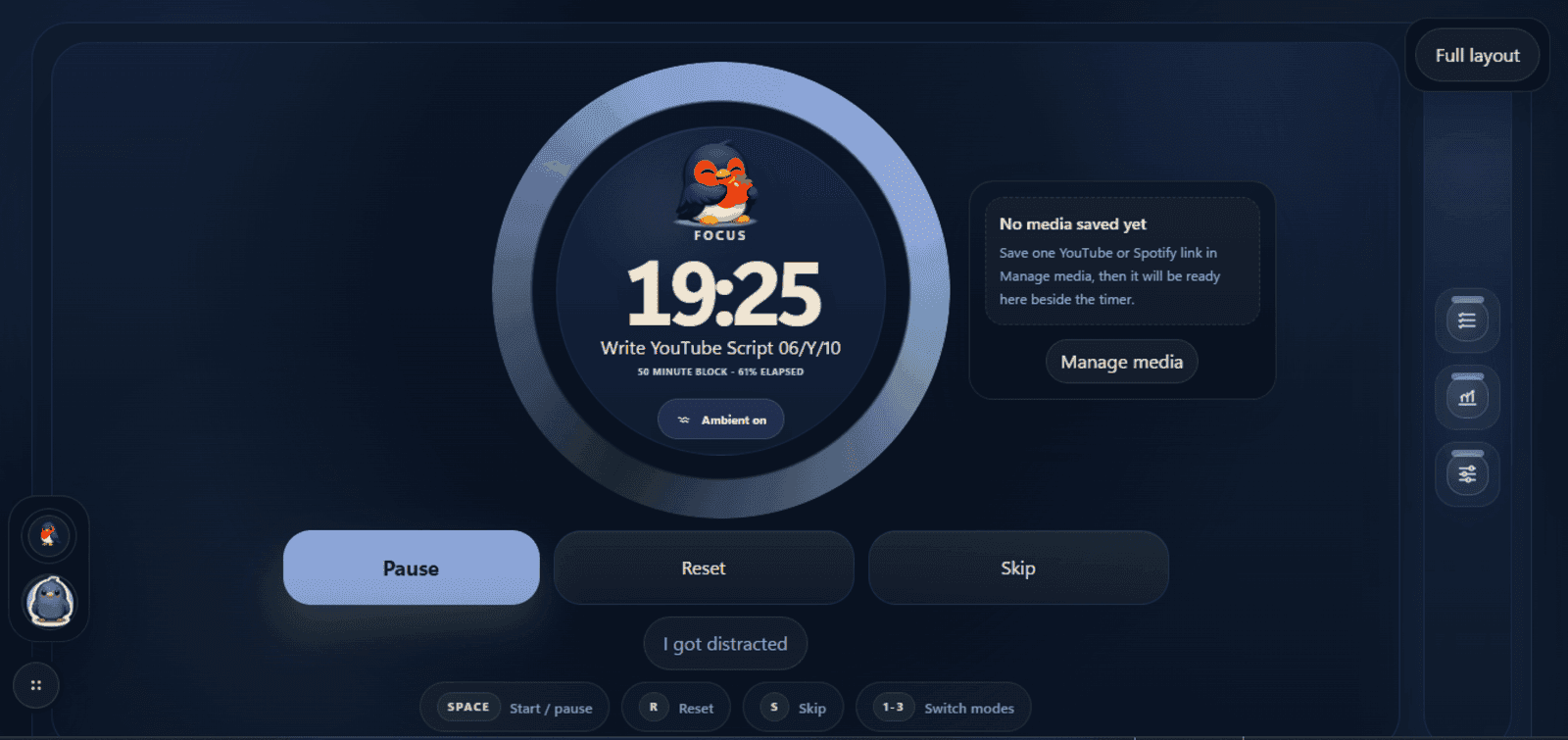
RobinFocus is an online pomodoro timer built to help people finish meaningful work in a structured way. At its core, it is a focus timer: you choose a block, start the session, work until the timer ends, then take the break the rhythm asks for. Around that timer, RobinFocus adds calm atmosphere, lightweight goals, and visible progression so the routine feels worth returning to.
That means RobinFocus is not trying to be only a bare utility clock and it is not trying to become a noisy productivity dashboard either. It sits in the middle: clear enough to work as a tomato timer, aesthetic enough to feel calm while you study, and structured enough to support deep work without overwhelming the session itself.
Some people come looking for a classic online pomodoro timer. Others want something closer to an aesthetic pomodoro setup, a study-with-me pomodoro rhythm, or a calmer deep-work surface. RobinFocus is designed to meet those overlapping needs without making the interface feel crowded.
Why the name RobinFocus
RobinFocus started as a pomodoro timer. Pomodoro is the Italian word for tomato, which is why so many focus tools still use tomato language today. Once that metaphor was already in the room, RobinFocus leaned into it instead of treating it like decoration.
The name came from American Robins and their well-earned reputation for enjoying tomatoes. In some gardens, robins are treated like tiny tomato thieves with feathers and excellent timing. That made the idea too good to ignore: if pomodoro already points to tomatoes, and robins love tomatoes, then RobinFocus became the natural name for a focus system where completed blocks could feel like tomatoes earned and eaten.
That is also why the logo is a robin. The bird is not just branding pasted on top of a timer. It is part of the app's metaphor: the user is the Robin, the completed block is the tomato, and the whole product is built around making that rhythm feel memorable instead of generic.
How the Robin and tomato system works
Inside RobinFocus, the user is the Robin. Each completed focus block counts as a tomato eaten. That means the timer is still the backbone of the product, but the progress is expressed in a way that feels lighter and easier to care about than abstract productivity numbers alone.
In practice, a session works like this: you set or accept a goal, start a focus block, finish the block, and RobinFocus records that progress as another tomato. Over time, the tomatoes you eat become the visible trail of your consistency. Instead of asking you to imagine progress in the abstract, RobinFocus lets you see it accumulating through blocks, streaks, and the reward shelf that grows around them.
This is also why the language inside RobinFocus keeps returning to tomatoes rather than treating them as a one-time joke. The metaphor helps connect the original pomodoro idea to the app's own personality. It gives the timer a story: the Robin is here to focus, the tomatoes are the blocks, and the session becomes something you can finish, count, and come back to tomorrow.

Rewards, assets, and Top Robins
RobinFocus rewards progress by turning completed focus into visible unlocks instead of leaving the session behind as a number you forget five minutes later. When you finish a qualifying block, you eat tomatoes, earn seeds, and gradually expand the reward shelf around your Robin.
The progression currently moves through several layers. As your tomatoes grow, RobinFocus unlocks tomato varieties, nests, titles, and celebration dishes. The app also uses seeds as a lighter secondary reward, which can be spent on parts of the broader asset system such as avatars, later nest tiers, and selected cosmetic or atmosphere-linked items. The basic idea is simple: the more consistent your focus becomes, the more your profile starts to look earned rather than default.
Those assets are not only decorative. RobinFocus uses an active loadout model, which means your currently equipped avatar, tomato variety, nest, title, and dish can add a small leaderboard bonus on top of your base focus score. Only unlocked or owned active rewards count, and the bonus is capped so the board still rewards consistent work more than collection alone.
That is where Top Robins comes in. The leaderboard is built around effective tomatoes rather than empty vanity rank. Completed public focus sessions between 10 and 60 minutes build the base score, and the active eligible loadout adds the small capped bonus on top. So the rank is not just about showing off assets, and it is not just about raw decoration either. It is about visible focus, consistent effort, and a profile that reflects the work you actually put in.
In other words, RobinFocus rewards are meant to make consistency feel tangible. Each tomato you eat moves the account forward. Each unlock makes the profile feel more lived in. And each asset gives the Robin a little more identity, so the practice of returning to focus starts to feel like a real progression loop instead of a disposable timer session.
Why RobinFocus uses rewards and habit structure
RobinFocus was built around a simple belief: it is easier to return to difficult work when the routine has structure and the progress feels rewarding enough to matter. The app therefore does not rely only on willpower. It gives the user a repeatable cue, a clear work routine, and a visible reward trail that makes the next session easier to start.
Habit research supports that direction. Work by Phillippa Lally and colleagues on real-world habit formation found that automaticity tends to grow through repetition in a consistent context, and that the process usually builds gradually rather than flipping on all at once. Wendy Wood and David Neal's work on habits and goals also argues that repeated behavior in stable contexts helps bind actions to cues, which is one reason structured focus rhythms can become easier to repeat over time.
RobinFocus uses rewards to support that loop, but not in a cartoonish way. The point is not to replace meaningful work with gimmicks. The point is to make progress easier to notice, easier to remember, and easier to want to repeat. Neuroscience research on reward learning and reward anticipation suggests that dopaminergic reward systems are involved in learning from expected and received rewards. In plain language, progress that feels salient and satisfying is often easier for the brain to learn from than progress that feels invisible.
That is why RobinFocus uses tomatoes, seeds, unlocks, and visible profile progression. They are not there only to make the app look playful. They are there to reinforce the focus habit itself: show up, finish the block, see the result, repeat the rhythm. Over time, the goal is for that loop to feel less like forcing yourself to start and more like a practice your brain already recognizes.
Planned recognition and awards
RobinFocus plans to recognize outstanding Robins not only inside the app, but in the real world too. The idea behind these awards is not spectacle for its own sake. It is to show that the time, consistency, and discipline a Robin puts into their work did not disappear into the void after the timer ended.
The first planned layer is monthly recognition. RobinFocus plans to recognize the top Robin each month with a custom RobinFocus plaque designed around that milestone. The second planned layer is annual recognition: one standout Robin of the year, chosen from the broader body of work and consistency across the season, is planned to receive a monumental RobinFocus trophy.
These awards are meant to reinforce the kind of community RobinFocus wants to build: a tight-knit group of people who care about completing their goals, doing it in a structured way, and seeing consistency treated as something worth honoring. The product starts with focus blocks and tomatoes, but the long-term vision is a culture where disciplined effort is visible, celebrated, and shared.
Because this recognition layer is still planned, the precise criteria, season rules, and fulfillment details can still evolve. The principle behind it, though, is already fixed: if a Robin puts in the effort, RobinFocus wants that effort to feel seen.